
Washington has fired openly on a merchant ship challenging its naval cordon around Iran for the first time in about a month. It did so on the same weekend that Qatari mediators were pressing both capitals to accept a fast-track de-escalation plan. The two moves sum up where the war stands eight months in: military pressure and diplomacy are moving in parallel, and neither has yet gained the upper hand.
What happened at sea
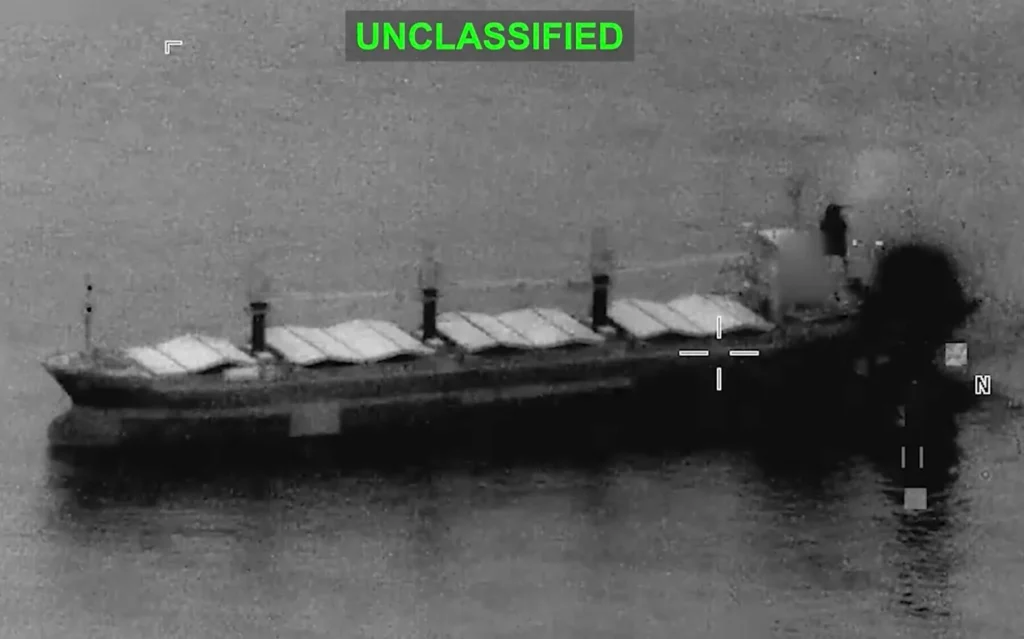
Late on Saturday, 7 November, US Central Command said its forces had disabled a vessel flagged in St. Kitts and Nevis. The ship had called at an Iranian port and was trying to leave the region despite repeated warnings to stop. It is the first publicly acknowledged strike on a cargo ship since an incident in the Gulf of Oman roughly four weeks earlier.
That same evening, Iranian state media reported explosions on Qeshm Island, which sits inside the Strait of Hormuz, and several blasts at the port of Jask on the Gulf of Oman coast. Neither report gave a cause, and the US military did not comment. Separately, Iran’s armed forces said two tankers had struck mines in the Hormuz area and caught fire. They did not say which flags the tankers flew or where they were headed.
The night before, President Trump told reporters that US forces had carried out limited strikes on an Iranian air-defence system, an action he called “minor.” CENTCOM has still not commented on it.
Defence Meridian analysis: The pattern matters. CENTCOM has now declined to confirm at least two recent operations, including the one the President himself described. Yet it announced the blockade interdiction quickly. Our reading is that this selective disclosure is deliberate. Enforcing a declared blockade is something Washington wants seen, because it shows resolve and backs up the economic pressure. Strikes on Iranian soil are kept ambiguous, which leaves Tehran room to avoid a direct response while talks continue.
The diplomatic track: a 48-hour bridge
Regional officials, speaking anonymously to the Associated Press, described a Qatari proposal designed to break the deadlock. It is meant to build trust in stages before the hardest issues are opened:
- Day one: The United States lifts its blockade of Iranian ports and releases part of Iran’s frozen overseas funds. In return, Iran admits International Atomic Energy Agency (IAEA) inspectors to the nuclear sites bombed by the US and Israel.
- Day two: Iran reopens the Strait of Hormuz under a revised arrangement it has worked out with Oman. Washington has not signed off on that arrangement. It would be temporary, pending a permanent framework negotiated with the wider Gulf states.
- After that: Comprehensive US–Iran talks on Iran’s highly enriched uranium stockpile and the rest of its nuclear programme.
The obstacle is sequencing. According to the same officials, Tehran is reviewing the plan but still refuses to discuss its nuclear programme until Washington meets a list of core demands. Those demands are an end to the blockade, sanctions relief, release of frozen assets, compensation for war damage, and a halt to hostilities across the region, including Israel’s operations in Lebanon. Trump has rejected most of these before, and he insists any deal to end the war must settle the nuclear file.
The nuclear sticking point
The IAEA puts Iran’s stockpile of uranium enriched to 60 percent at 440.9 kg (about 972 lb). Weapons-grade material is around 90 percent, and getting from 60 to 90 percent is a short technical step. No civilian power programme needs uranium enriched that high, which is why the stockpile sits at the centre of US demands. Iran says its programme is peaceful.
The two sides have been close to a deal before. In June, Washington and Tehran signed a memorandum of understanding setting out a path to a permanent settlement. It fell apart within weeks as each side accused the other of violating it, and the conflict has been an armed stalemate since, with intermittent exchanges of fire.
Pressure points to watch
- The military calendar. Reporting this week suggests CENTCOM is finishing preparations for possible renewed large-scale operations. Officials have pointed out that 9 November is a new moon, the kind of darkness planners favour for air campaigns.
- Shipping and oil. October saw more attacks on commercial ships in Hormuz than any month since March, as Tehran tries to make the blockade costly for Washington. Brent crude moved back toward $100 a barrel this week after briefly falling on hopes of a post-midterm settlement.
- Lebanon. Israel has warned Beirut that fighting will resume if Hezbollah joins any renewed round of the Iran war. Iran’s demand that Israeli operations in Lebanon end ties that front directly to the bargaining table.
- US domestic politics. The 3 November midterms changed the political picture in Washington. The incoming House majority has said ending the war is a priority, adding pressure on the White House to choose between escalation and a deal.
Bottom line
This weekend’s events show both sides building leverage before talks. Washington is showing it can strangle Iran’s maritime trade at will, while still keeping strikes inside Iran deniable. Tehran is showing that mines and harassment can keep the world’s most important oil chokepoint dangerous. The Qatari bridge offers a way out that lets each side claim the other moved first. Whether it holds depends on a question neither side has answered: which concessions come before the nuclear talks, and which come after.